

The real question is not quiet vs. loud
Introversion vs extraversion at work is usually explained too simply. The common version says introverts are quiet and extraverts are social. That sounds neat, but it does not help much when a quiet teammate gives the strongest presentation in the room, or when a friendly coworker needs a full hour alone after a heavy meeting block.
A more useful question is this: what kind of stimulation helps you think, and what kind of stimulation drains you when it repeats all day? The APA Dictionary entry on extraversion frames the trait around an outward orientation of interest and energy, while introversion is often discussed as the inward-facing side of that same broad personality dimension. In daily work, that means the practical issue is not whether someone is social enough. It is whether the environment gives their attention the right kind of input.
This matters because work is full of invisible energy costs. Meetings, brainstorms, open offices, Slack threads, camera calls, travel days, and unclear decisions do not affect everyone the same way. When a team treats one energy style as the default, the other style starts looking like a performance problem even when the person is doing strong work.
How energy style shows up during the workday
At work, energy style usually appears in three places: meetings, focus, and recovery. An introverted teammate may prefer an agenda before speaking, write better than they improvise, and produce their clearest thinking after a quiet block. An extraverted teammate may build ideas by talking, notice room energy quickly, and feel momentum when work is visible and interactive.
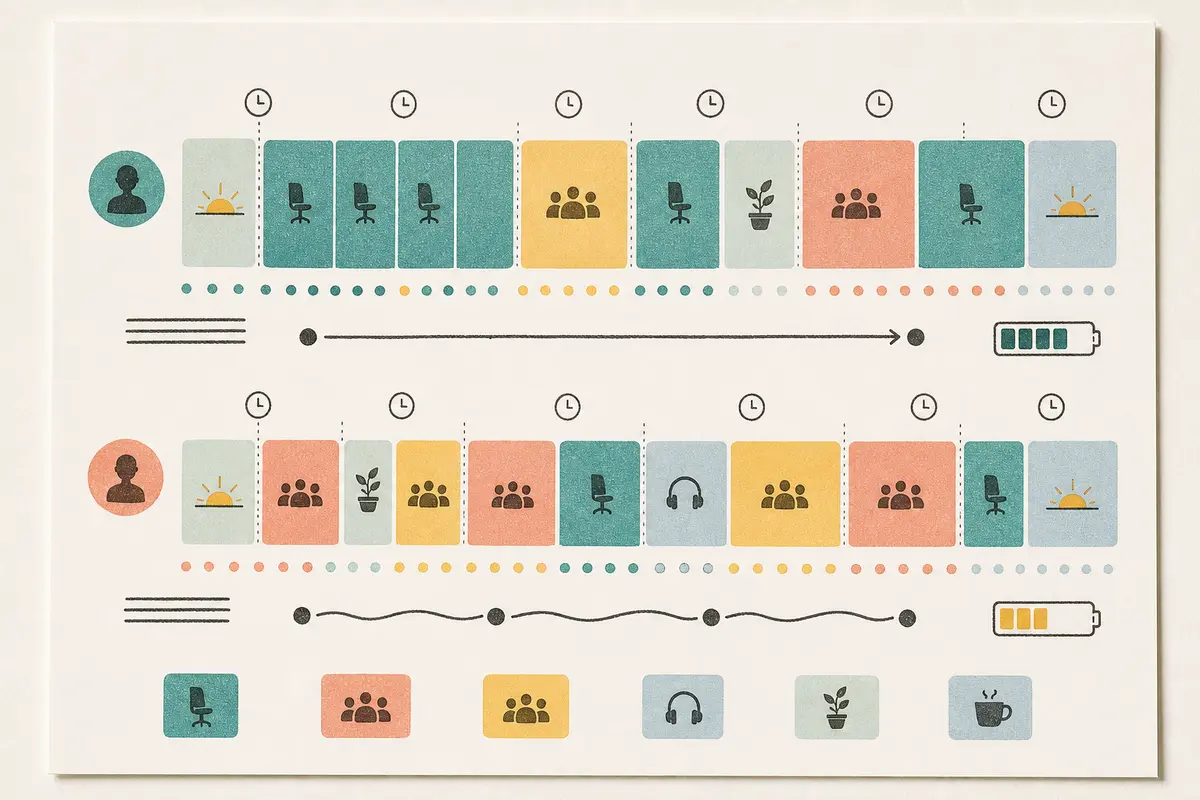
The mistake is to confuse style with skill. A person who needs time before answering is not automatically slow. A person who talks through a half-formed thought is not automatically careless. The real question is whether the team has enough structure for both ways of thinking to contribute before decisions are made.
- Meetings: Introverted workers often contribute better when the goal and decision point are clear before the call.
- Focus: Extraverted workers may lose energy when they are isolated for too long with no feedback loop.
- Recovery: Both styles need recovery, but the trigger can differ. One person recovers from noise; another recovers from silence and stagnation.
A practical energy audit you can run this week
If you want useful insight, do not start by asking whether you are an introvert or an extravert. Start with a one-week energy audit. After each major work block, rate two things from 1 to 5: how much energy it gave or took, and how clear your thinking felt afterward. The pattern is usually more honest than the label.
Look for repeat signals. Maybe you can handle a big workshop if you get 30 minutes before it to prepare. Maybe you love collaboration but feel scattered after five short calls. Maybe you are not antisocial at all; you are just overloaded by unclear conversation. Maybe you are not unfocused; you are under-stimulated by long solo blocks.
The point is not to protect yourself from every discomfort. Work always asks for flexibility. The point is to stop using the wrong solution. If the real problem is low preparation, more confidence advice will not fix it. If the real problem is isolation, another productivity app will not fix it. Energy style tells you what condition to change first.
When two good workers look unequal
Imagine a product team with two strong contributors. One is quick in live discussion and helps the room move. The other is quiet in the meeting but sends a sharp analysis afterward. A weak manager may label the first person as leadership material and the second person as less engaged. A better manager asks a more precise question: when does each person do their best thinking?
The fix can be simple. Send the decision question 24 hours early. Give five minutes of silent notes before debate. End the meeting by asking for written objections by the next morning. Now the live thinker still gets movement, and the reflective thinker is not forced to compress deep judgment into a fast answer.
Good collaboration is not making everyone contribute in the same style. It is designing the room so different styles can affect the outcome.
This kind of adjustment is small, but it changes what the team can see. The quiet person is no longer hidden. The energetic person is no longer carrying the whole conversation. The decision gets stronger because the process collects more than one kind of intelligence.
What not to do with the label
The label becomes harmful when it turns into an excuse or a judgment. Introversion should not become a reason to avoid every difficult conversation. Extraversion should not become permission to dominate every room. The useful version of the idea is practical: it helps you notice what conditions make good work more likely.
Watch for lazy interpretations. If someone is quiet, ask whether the meeting format gives them a real opening. If someone is talkative, ask whether their talking is clarifying the problem or taking oxygen from others. If you are drained, ask whether the task was wrong for you or whether the schedule gave you no recovery.
Also remember that trust changes behavior. Many people look introverted in unsafe rooms and more expressive in rooms where they are not punished for imperfect thoughts. Many people look extraverted during exciting work and then disappear when they need to recover. A single meeting is not enough data to define a person.
A collaboration playbook for both styles
If you lead a team, design for both preparation and interaction. That means agendas before meetings, silent thinking time inside meetings, and written follow-up after meetings. It also means leaving space for live discussion, fast feedback, and visible momentum so work does not become a private guessing game.
- Use written prompts before high-stakes meetings.
- Start brainstorms with private notes, then share.
- Rotate who summarizes the decision so one style does not own the room.
- Protect focus blocks after heavy collaboration blocks.
- Invite quick verbal processing, but separate it from final commitment.
If you are managing yourself, make one small change first. Do not overhaul your personality. If meetings drain you, add a recovery block after the worst one. If solo work flattens you, add a short feedback loop before the afternoon. The right adjustment should make the day feel clearer, not smaller.
Use the label to redesign the day
Introversion vs extraversion at work is most useful when it points to design, not identity. The goal is not to decide who is quiet, loud, social, or reserved. The goal is to understand how people create, process, recover, and contribute under real working conditions.
Before your next workday ends, ask one question: which part of the day made your thinking sharper, and which part made it noisier? That answer will teach you more than a label by itself. If you notice the same pattern for a full week, you have a practical starting point for better meetings, better focus, and better collaboration. If your energy pattern also shows up after warm social moments, read why you chat warmly and then need space next. If you want a personal read on the pattern, start with the Traitiva personality test after you finish reflecting on the week.


